







In the world of construction, landscaping, and heavy-duty material handling, the wheelbarrow is often taken for granted…until it fails. For decades, professionals have defaulted to steel trays under the assumption that weight equals strength. And while early poly wheelbarrows earned a reputation for being lightweight but less durable, advancements in materials and engineering have disproved that long-held belief.
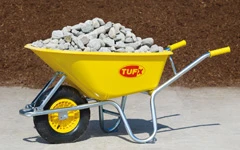
One product drawing increasing attention in contractor circles is the PX120, a premium Canadian poly wheelbarrow manufactured by Tufx-Fort Manufacturing in Waterloo, Ontario. Marketed as a top-tier contractor solution, the PX120 appears to represent a shift in how durability and performance are defined in this category.
Rethinking Strength: Beyond Steel
The traditional argument for steel has always centered on toughness. However, steel trays are inherently rigid - meaning that under extreme impact, they are prone to denting or catastrophic deformation. Once compromised, performance quickly declines.
The PX120 approaches the problem differently. Its tray is constructed from a proprietary blend of polypropylene and polyethylene using 100% virgin materials. This formulation prioritizes controlled flexibility. Instead of resisting force until failure, the tray absorbs and dissipates impact energy - returning to its original shape rather than permanently deforming.
Numerous independent videos circulating online appear to demonstrate this capability, with heavy rocks dropped from height directly into the tray. In scenarios where steel would typically buckle or fail, the PX120 maintains usability. While such demonstrations are anecdotal, they highlight a key design philosophy: resilience through flexibility rather than rigidity. There is even one video that has an earth moving machine using its bucket to deliberately squash the tray, which when released, simply returns to original shape.
Engineering That Goes Beyond Appearances
A common trend in the market has been the emergence of lookalike products attempting to replicate the visual design of the PX120. However, performance differences often emerge under stress, where underlying engineering matters most.
The PX120 features a single-piece steel frame formed from one continuous tube, shaped using a 5-axis CNC bending process. This approach allows for precise geometries and eliminates common weak points such as weld joints found in multi-piece frames.
The frame is finished with a bright zinc coating, offering strong corrosion resistance - an important consideration for contractors working in varied and often harsh environments.
More notably, the frame design works in conjunction with the flexible tray. Under extreme loads, the system is engineered to allow controlled movement: the tray flexes while the frame maintains structural integrity. This balance reduces the likelihood of permanent damage and extends the product’s usable life.
Load Capacity Meets Real-World Use
Beyond materials and construction, the PX120 is positioned among the higher-capacity wheelbarrows available in its class. For contractors, this translates into fewer trips, improved efficiency, and greater confidence when handling heavy or irregular loads.
While lighter poly wheelbarrows have historically appealed to homeowners and light-duty users, products like the PX120 are clearly aimed at demanding professional environments - where durability is measured not just in specifications, but in years of consistent performance.
A Category Evolving
The evolution of poly materials and modern manufacturing techniques is reshaping expectations in the wheelbarrow market. Where steel once dominated by default, newer designs are offering compelling alternatives that blend strength, flexibility, and longevity.
The PX120 from Tufx-Fort Manufacturing stands out as an example of this shift. By combining proprietary materials with engineered structural design, it challenges conventional assumptions and suggests that, indeed, not all wheelbarrows are created equal.
For contractors and professionals evaluating their next investment, the question may no longer be steel versus poly—but rather, which design is built to endure the realities of the job site.